
Indian equity benchmarks Sensex and Nifty experienced a decline in early trade, primarily due to a sell-off in power and metal stocks, mirroring a broader downturn across Asian markets. Elevated crude oil prices and firm US bond yields further dampened investor sentiment, while an expert warned of an impending correction in overvalued mid and small-cap segments. Track Sensex, Nifty on October 22.

This may point to the beginning of a rising role of whistleblowers in aiding stock-market policing amid the rapid expansion in capital markets in recent years.

Indian benchmark indices Sensex and Nifty traded lower in early sessions due to profit-taking and significant foreign institutional investor (FII) outflows, despite strong performance from IT stocks like Tech Mahindra. Track Sensex, Nifty on October 16.

Senior SAD leader Harsimrat Kaur Badal has written to Union Home Minister Amit Shah, requesting a CBI probe into the murder of anti-drug activist Parvinder Singh Jhota in Mansa. She also called for an investigation into the alleged politicians-police drug trade nexus in Punjab, citing claims by Jhota's father about a wider conspiracy.
Indian benchmark indices Sensex and Nifty closed higher for the second consecutive day, primarily driven by robust buying in IT stocks following strong quarterly results and positive global trends. Tech Mahindra notably surged over 8% after reporting a significant jump in net profit.

Pakistan and the Maldives have signed 20 Memorandums of Understanding (MoUs) covering defence, maritime security, artificial intelligence, trade, and other sectors during Maldivian President Mohamed Muizzu's three-day visit to Islamabad. The agreements aim to significantly boost bilateral cooperation and trade, with Pakistan also offering technical expertise and educational opportunities.

US Secretary of State Marco Rubio visited Reliance Industries' Jamnagar refinery, a day after calling India a crude oil refining 'superpower', and met with top Indian business leaders Gautam Adani and N Chandrasekaran to advance bilateral ties in energy, trade, investment, and defence.

'We are open to all countries around the world as long as we get a fair deal, as long as we are ensured continuity in the engagement.'

Amid the ongoing protests in the national capital, the Bharatiya Udyog Vyapar Mandal (BUVM), Delhi Pradesh, has written to Prime Minister Narendra Modi, Leader of the Opposition Rahul Gandhi and Aam Aadmi Party national convenor Arvind Kejriwal, appealing for political demonstrations in the capital to be postponed until January 31, 2027, citing the festival and wedding season.

The 200-DMA is a closely watched indicator of a stock's long-term trend and can serve as an early warning of trouble.
Indian benchmark indices Sensex and Nifty saw a sharp rebound in early trade, driven primarily by a rally in IT stocks and a decline in crude oil prices, even as global markets faced selling pressure due to US inflation concerns. Track Sensex and Nifty on

Trade negotiations between the United States and Canada have collapsed, leading to the US imposing 50% tariffs on nearly $28 billion worth of Canadian imports, with Canada immediately vowing to retaliate dollar-for-dollar.

External Affairs Minister S Jaishankar will host US Secretary of State Marco Rubio in Mumbai on October 20 for talks aimed at strengthening the Comprehensive Global Strategic Partnership. Discussions will cover energy, trade, defence, and critical technologies. The visit also includes celebrations for the 250th anniversary of US Independence. This meeting follows earlier confusion regarding Rubio's visit and will also touch upon the India-US bilateral trade agreement, which both sides are close to concluding. The MEA clarified that hosting foreign dignitaries outside Delhi is a common practice.

The US-Canada trade war has escalated sharply, with US President Donald Trump on Monday announcing that tariffs on Canadian cars, trucks, automotive parts and steel imports will be raised to 50 percent from January 2027, following the collapse of trade negotiations between Washington and Ottawa last week.

Indian stock markets are set to be influenced this week by a confluence of factors including quarterly corporate earnings, the US Federal Reserve's interest rate decision, fluctuations in crude oil prices, and ongoing geopolitical developments in West Asia.

Speculation surrounding Hardik Pandya's future with Mumbai Indians in the IPL continues, with reports indicating MI has not yet committed to a trade despite interest from Chennai Super Kings and Kolkata Knight Riders.

The Congress has criticised Prime Minister Narendra Modi for his "deafening silence" regarding reported face-offs with the Chinese Army in Arunachal Pradesh.

Union Home Minister Amit Shah, during his Punjab visit, urged Chief Minister Bhagwant Mann to transfer drug-related death investigations in Sangrur and Batala to the CBI, following Mann's decision to hand over anti-drug activist Parvinder Singh Jhota's murder case to the central agency. Shah met families affected by drug-related incidents and pledged to make Punjab drug-free by December 31, 2029, calling for collective action against the menace.

Expiry day can make an otherwise ordinary trading session feel unusually fast. Index prices may move sharply around important strikes, option premiums can change quickly, and a position that looked manageable in the morning can behave very differently later in the day.

Defence Minister Rajnath Singh on Tuesday called for dialogue and diplomacy to resolve global conflicts, stating, "war can never be the answer to war," while addressing the Shanghai Cooperation Organisation (SCO) Council of Heads of Government meeting in Dushanbe, Tajikistan.

Thousands of protesters, including farmers, trade unionists, students, and Left party members, marched towards the Election Commission of India headquarters in Delhi, demanding the resignation of Chief Election Commissioner Gyanesh Kumar and the withdrawal of the ongoing Special Intensive Revision (SIR) of electoral rolls, alleging 'vote chori' and exclusion of eligible citizens.
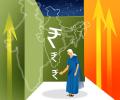
The International Monetary Fund (IMF) has increased India's growth forecast to 7 per cent for 2026-27, up from 6.4 per cent, attributing this robust outlook to resilient domestic demand and strong services activity, positioning India as one of the fastest-growing major economies.

Indian benchmark equity indices, Sensex and Nifty, closed lower for the fourth consecutive session, driven by a surge in crude oil prices above USD 114 per barrel due to escalating tensions in West Asia, coupled with broad-based selling and FII outflows.
Indian benchmark indices Sensex and Nifty saw an early rebound, driven by strong performances from blue-chip HDFC Bank and major IT firms like HCL Tech, which reported a significant rise in net profit. Track Sensex, Nifty on October 13.

US Secretary of State Marco Rubio has characterised the strategic alignment between India and the United States as "extraordinary", emphasising that both nations have an opportunity to shape the course of the 21st century through partnership.

Indian benchmark indices Sensex and Nifty opened higher, extending their previous session's rally, driven by a decline in global oil prices, despite continued selling by Foreign Institutional Investors.

Navigating this geopolitical minefield requires a cold-blooded blend of immediate tactical pleading, structural domestic diversification, and aggressive collective resistance, suggests Ambassador Rajasekhar.

The Mumbai crime branch has dismantled an interstate drug syndicate, seizing over two kilograms of high-grade heroin worth Rs 10.16 crore and arresting three individuals. The operation is part of a larger drive against narcotics networks in the city, with further investigations underway to trace the supply chain and apprehend more involved parties.

Foreign Portfolio Investors (FPIs) have withdrawn Rs 48,056 crore from Indian equities in October, driven by elevated crude oil prices, Middle East tensions, inflation concerns, and weak corporate earnings, though selling pressure moderated towards the end of the month.

Left-arm pacer T Natarajan has been traded back to Sunrisers Hyderabad, while leg-spinner Zeeshan Ansari has moved to Delhi Capitals in a player trade between the two IPL franchises. Natarajan returns to SRH for a revised fee of Rs 5 crore, having previously been bought by DC for Rs 10.75 crore at the IPL 2025 auction. Ansari joins DC at his existing fee of Rs 40 lakh.
Indian equity benchmarks, the Sensex and Nifty, opened higher on Friday, driven by a strong rally in IT stocks, despite a significant overnight decline in US technology shares and broader Asian markets. Experts anticipate further market support from falling US bond yields, a strengthening rupee, and a substantial liquidity inflow following the Jio Platforms IPO allotment. Track

'The political leadership is very clear that we have to move towards the integration of the three services into theatre commands.'
Indian equity benchmarks Sensex and Nifty extended their losses for a third consecutive session, with the Sensex declining 460.30 points and the Nifty dropping 123.70 points, primarily due to surging crude oil prices driven by escalating tensions in West Asia and weak global cues.

Delhi Police seized 2,375 kg of green firecrackers from an illegal godown in Haiderpur village, northwest Delhi. Two individuals, Rohan Gaba and Bhavya Jaggi, were booked for unauthorised storage as they lacked valid licences, despite intending to sell the crackers after obtaining one.

The advisory, issued on Wednesday, urges Indian nationals to avoid large gatherings and crowded places where protests are occurring and to follow local authorities' instructions.

Farmers under the Samyukta Kisan Morcha have initiated a week-long protest at the Chandigarh-Mohali border, demanding a minimum support price (MSP) based on the C2 plus 50 per cent formula, debt waivers, and opposing the proposed India-US trade deal, Electricity Amendment Bill, and Seed Bill. They also raised concerns about water depletion and sought resolutions based on riparian principles.

Nurpur police froze assets worth Rs 74.12 lakh belonging to Ramesh Kumar, an accused in an NDPS Act case. The frozen assets include a building and a tractor, acquired through alleged illicit drug trade, as part of a broader campaign against drug trafficking in the state.

Artificial intelligence company Anthropic, known for its Claude AI chatbot, has filed a registration statement with the US SEC for its proposed initial public offering (IPO), intending to list its Class A common stock on the Nasdaq Global Select Market under the ticker symbol 'ANT'.

Massive nationwide protests in France over the rising cost of living and underfunded public services turned violent, with nearly 1,000 people arrested and key urban centres hit by tear gas and clashes.

External Affairs Minister S Jaishankar stated that the stability of the Line of Actual Control (LAC) is essential for normalising India-China relations, asserting that border disturbances will have consequences. He connected trade and investment growth to border peace and highlighted significant economic issues, including a severe trade imbalance and lack of market access for India in China. Jaishankar also referenced the 2020 Galwan clashes as a critical turning point, underscoring the profound impact of border tranquillity on the overall bilateral relationship.
